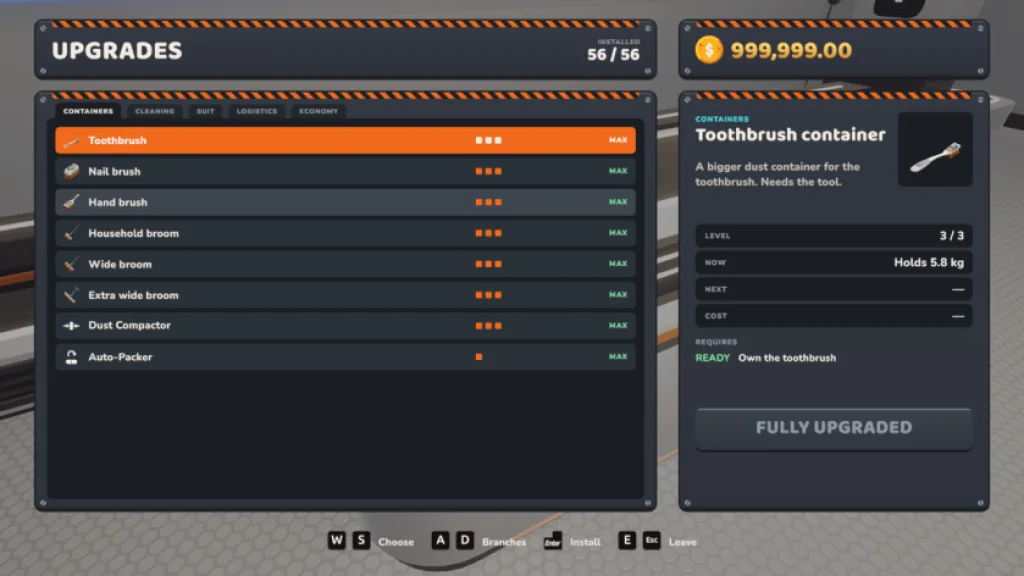
Which upgrade should come next?
A higher specification is useful only if the rest of your route can handle it. A larger hopper can reduce returns, but it cannot clear a blocked receiving belt.
The order below is a decision framework, not a claim that one purchase sequence is mathematically best. Read the upgrade’s current description and prerequisites in your save; this page deliberately avoids an unverified price tree.
| Bottleneck | Priority to compare | Reason to postpone |
|---|---|---|
| Dust enters the tool slowly | Cleaning coverage or collection improvement | Your container already fills before a useful pass is complete. |
| Tool fills too often | Capacity on the tool you use | You intend to replace that tool immediately. |
| Walking dominates each sale | Shorter transfer route or conveyor delivery | The intake is already next to the cleaning area. |
| Vehicle repeatedly returns half-used | Route planning and accessible unloading | A larger vehicle would take the same poor route. |
| Output queues behind a machine | Downstream output and power checks | Buying more collectors would only grow the queue. |
| Everything flows smoothly | Read an economy upgrade’s eligible payout and cost | The extra payout is unclear or does not apply to your main activity. |
Compare the whole purchase, including prerequisites
Read the exact scope of the upgrade
Check whether it applies to a held tool, a vehicle, your suit or the shared matrix. Similar wording does not make those purchases interchangeable. Record the current value and the next value in the menu.
Add the supporting costs
For a transport purchase, include the building tool if needed, a receiving building and all required connections. For a vehicle, account for the garage and an unload route. Avoid spending the whole balance on an item that cannot yet feed your existing system.
Keep one functioning earning route
Leave yourself a way to continue selling while you expand. A simple direct-to-intake line can fund later processing. Do not make your only source of income depend on several untested machines becoming ready at once.
Compare before and after
Use the same general area and a similar load. Note time spent cleaning, returning and waiting to unload. If the delay moved to another stage, stop buying more of the same upgrade and reassess.
Three decisions that often change your upgrade order
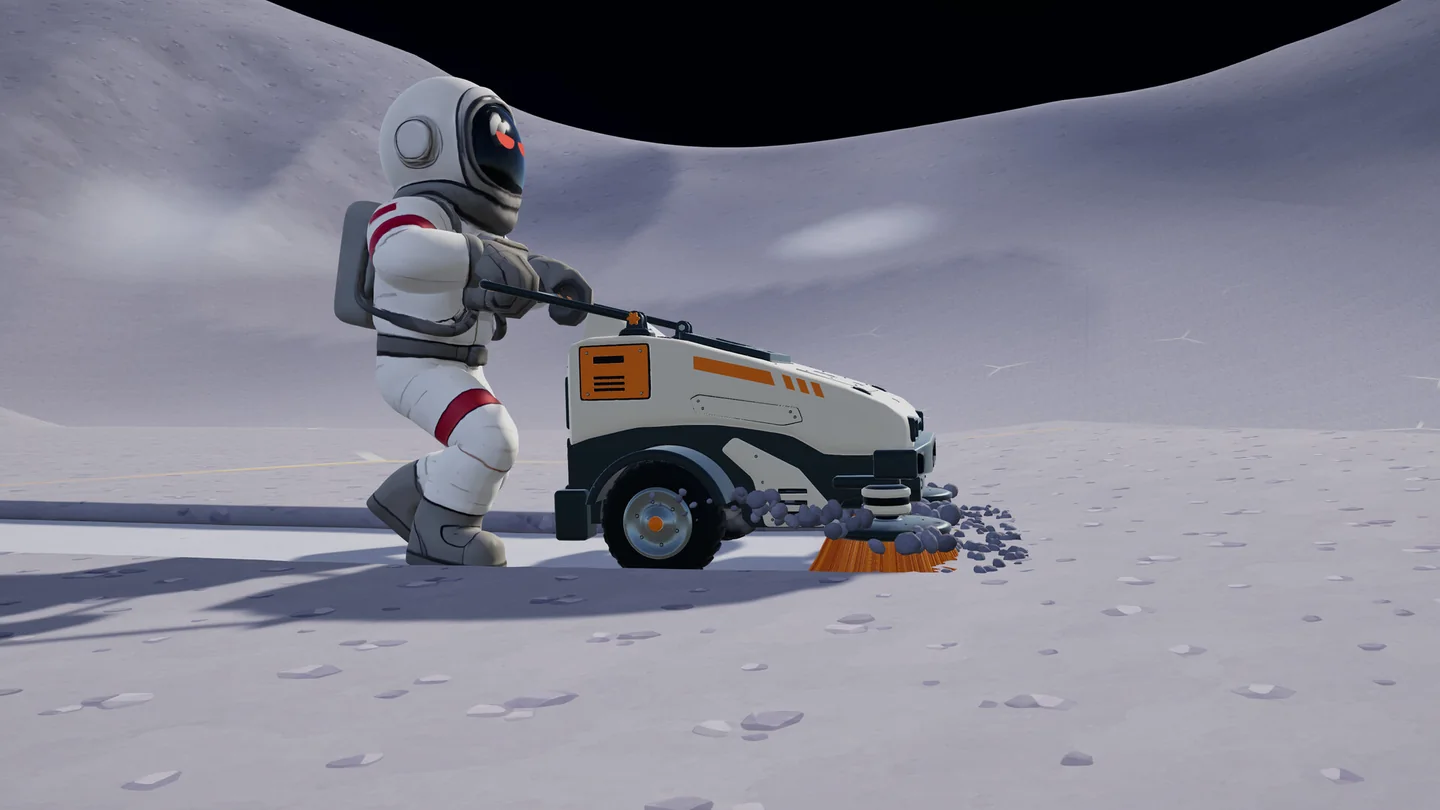
A larger cleaning footprint is only one part of an upgrade decision; also check carrying capacity and the return route.
Official screenshot · DragDrop Games / Steam ↗A temporary brush versus a long-term tool
A cheap capacity upgrade can be useful when it removes many short trips. It can be poor value if you are about to stop using that brush. Compare the remaining work you intend to do with it, not just its low purchase price.
A wider cleaner versus a better delivery route
More cleaning output needs somewhere to go. If your silo is rising while the outgoing belt stalls, fix transport first. If the receiving route is empty and working, collection may be the stage worth improving.
Economy improvements versus completing a system
An economy upgrade can improve a qualifying reward, but it cannot sell dust stranded in the field. Read which payment changes and make one qualifying sale or completion afterward. A larger number in one menu is not proof of higher earnings across the whole session.
Plan around the v1.0.5 building changes
Placed structures can be moved with the building tool’s Move Mode, and removing a structure refunds its full price. This makes correcting a bad layout less costly than older guides suggest. Attached belts follow only where they can reach, so inspect connections after moving a machine.
These are structure rules. Do not treat the full building refund as a promise that every tool, matrix level or vehicle can be refunded. Read the action shown for the specific purchase.
| What you observe | Check |
|---|---|
| No visible improvement | Confirm the upgrade affects the active equipment and compare its displayed values. |
| Larger loads but no more income | Follow the material to sale; check for growing queues. |
| A co-op player sees a different result | Compare the host’s matrix and current session before repurchasing. |
| A moved machine stops delivering | Inspect its ports and the reach of every attached belt. |
Questions & answers
Is there one best upgrade order?
Not one verified for every save. Tool choice, travel distance, crew size and transport capacity change which purchase is useful next.
Should I upgrade every broom?
Compare an upgrade with how long you plan to use that tool. Buying every intermediate improvement can delay the equipment or complete transport route you actually need.
Can I refund upgrades using the building tool?
The v1.0.5 full-refund rule concerns removing placed structures. It does not establish a refund for matrix levels or other shop purchases.
Sources & evidence
- DragDrop Games — Steam store ↗
Official game description, languages and Windows requirements.
- DragDrop Games — v1.0.3 ↗
Official shared Upgrade Matrix, conveyor payments and garage management.
- DragDrop Games — v1.0.5 ↗
Official building, catcher routing, garage status and sector fixes.