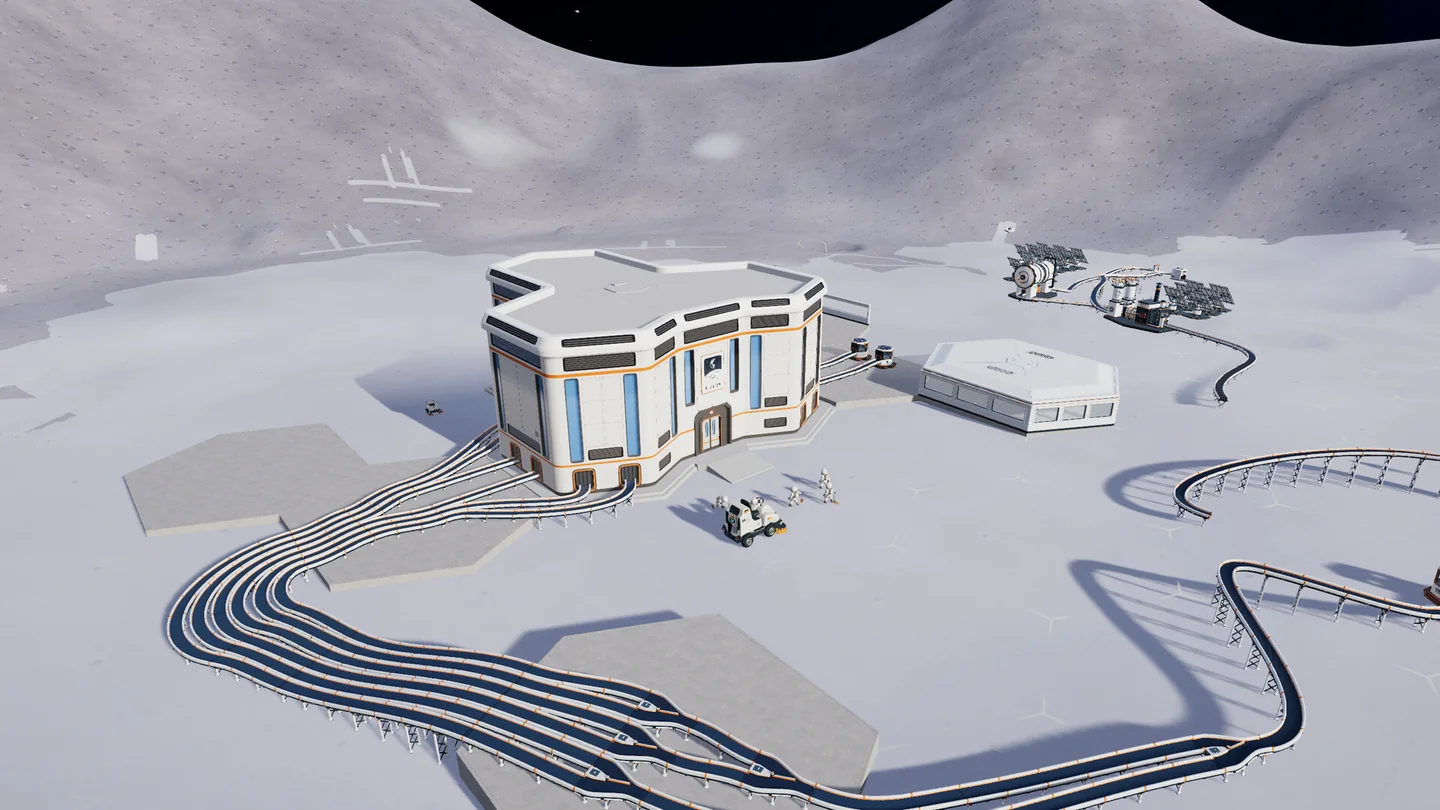
Separate collection, transport and production
- 01Hand tool→
- 02Packager→
- 03Output conveyor→
- 04Depot intake
- 01Vehicle→
- 02Garage collector + silo→
- 03Output conveyor→
- 04Depot intake
- 01J.O.O.N.A.S.→
- 02Capsule Catcher→
- 03Direct sale / optional belt→
- 04Verify payment or receipt
Each arrow is a hand-off: confirm the source drains and the next stage receives. If you add processing, verify its accepted input and outgoing route separately.
The catcher’s direct-sale/belt branch is a check based on the linked third-party analysis.
Moon Sweepers automation is several connected jobs. A Packager moves dust out of a hand tool; a garage handles a vehicle’s unloading route; J.O.O.N.A.S. delivers capsules to catchers. None of those facts means that a disconnected destination can receive and sell the material.
Use this conceptual flow to identify your source. It describes the roles of the stages, not the exact geometry of an in-game layout.
The garage collector pad, suction hose and rear conveyor outlets are described by a Steam Community player, not an official equipment specification. Compare that report with your garage layout and status messages.
For catchers, the linked third-party analysis reports a direct-payment path without an output belt and a separate conveyor path when connected. The conveyor route below is an option to test, not a requirement for every robot setup.
| Source | First transfer | Route to revenue |
|---|---|---|
| Handheld cleaning | Packager | Output conveyor → station intake |
| Vehicle cleaning | Garage collector and silo | Silo outfeed → conveyor → station intake |
| J.O.O.N.A.S. | Capsule Catcher group | Optional conveyor route → compatible receiver; test direct payment separately |
| A processing stage | Accepted input material | Machine output → compatible next stage → final intake |
Commission a minimal line before extending it
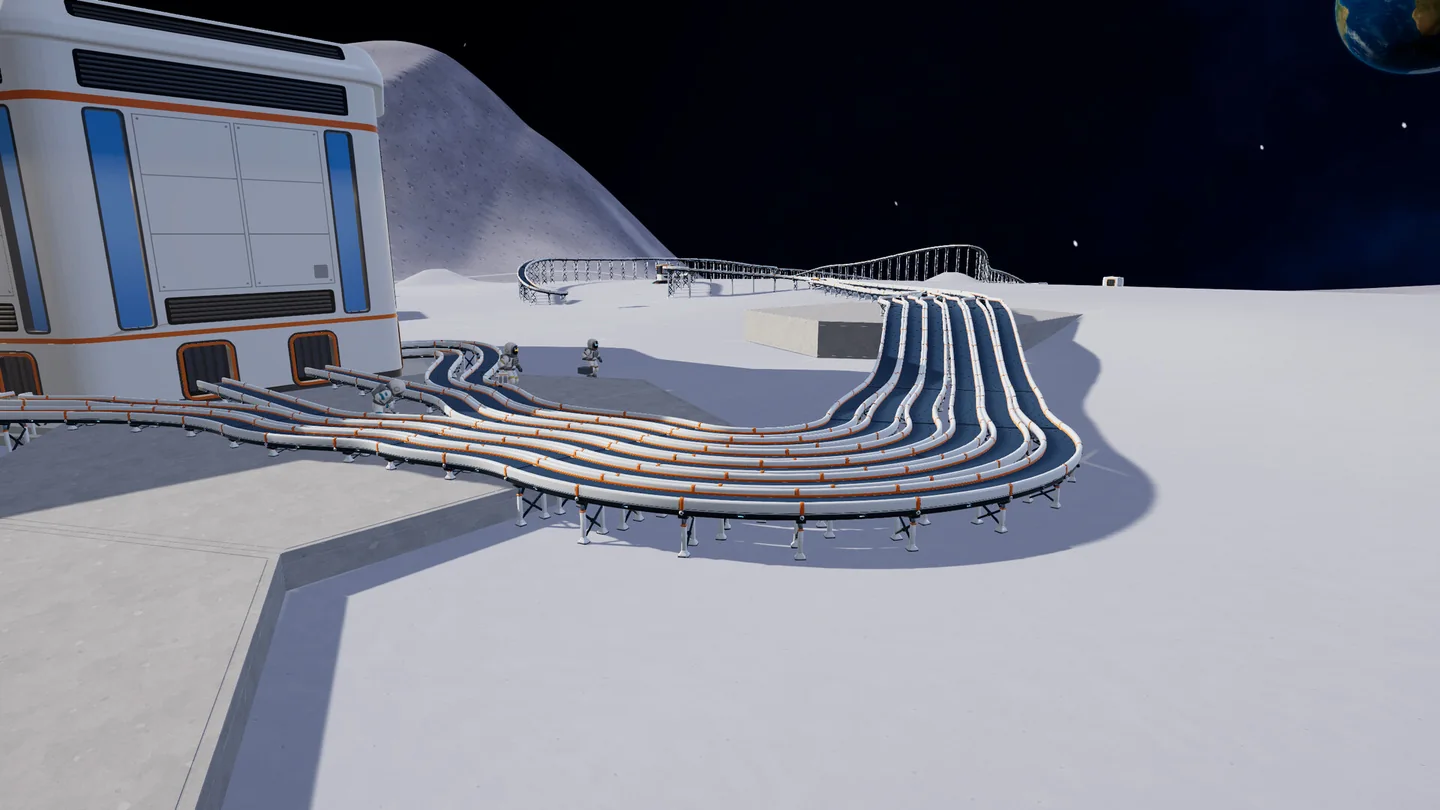
Trace the belt all the way to the station connection. A nearby belt is not the same as an attached one.
Official screenshot · DragDrop Games / Steam ↗Prove the destination
Locate the receiving intake. Build the short delivery route where you can follow it on foot. Confirm that the final segment enters the intended port instead of merely passing close to the building.
Feed one small load
Use a single source, such as a Packager loaded from your tool. Watch the source gauge, the first capsule and the receiving display. A route is ready to expand only when all three show the expected change.
Check payment independently of storage
The developer’s v1.0.3 notes state that dust and stone delivered by belt pay on arrival. If a source or silo fills but the balance does not change, material may still be in transit or waiting. Identify the first uncompleted transfer.
Repeat without intervention
Send a second small load. Watch for a queue that grows rather than clears. A successful single capsule proves connectivity; repeated loads help reveal a downstream bottleneck before you add more collectors.
Add one processing stage at a time
Before inserting a machine, read its accepted inputs and outgoing material in the current build. Keep unlike materials routed to their matching inputs. Do not infer a recipe from the machine name or connect both branches without checking the labels.
Add one stage, feed a small batch and observe the output. If it needs power, check the game’s supply and demand indicators rather than using an unverified generator-to-machine ratio. Once the output travels onward, compare the result with your direct sale route.
A split can feed separate destinations; a merge combines incoming routes. The v1.0.4 notes say mergers alternate between their inputs and improve shared belt building in co-op. Alternation is not a guarantee that an overloaded downstream machine can accept the combined flow.
Distinguish a power problem from a transport problem
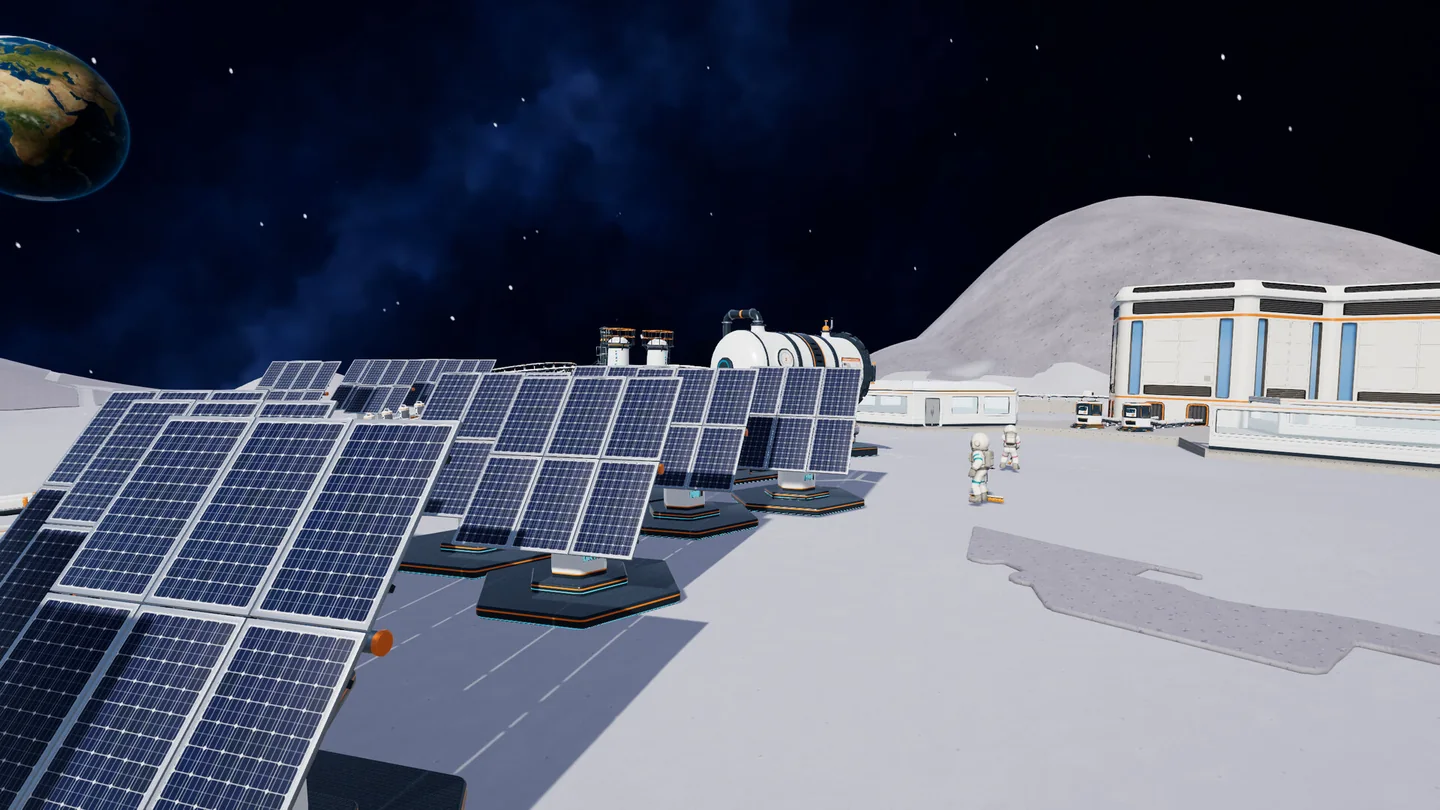
Inspect supply and demand in your own setup. The panel count in this promotional scene is not a tested power ratio.
Official screenshot · DragDrop Games / Steam ↗| What you can see | Next check | Do not assume |
|---|---|---|
| Input empty, output empty | Trace the input belt back to its source. | That adding power will create missing material. |
| Input present, machine reports no power | Check the required supply and connections. | That every building has the same requirement. |
| Machine works but output backs up | Inspect the next receiver and its outgoing path. | That another upstream machine will help. |
| Only a branch stalls | Compare its accepted material and belt direction. | That the whole factory is broken. |
| Supply changes during a session | Read the live power indicators under that condition. | An exact night-time battery budget without measurements. |
| Packing fails across a large base | Check the v1.0.5 packing fix and capsule backlog. | That all packing failures are caused by electricity. |
Expand only the stage that is limiting the route
Find the first sustained queue
Watch a representative run. For a catcher using a conveyor route, inspect its connected output if storage rises while the destination keeps accepting. If all belt outputs back up near the intake, start at that shared destination rather than replacing every source. Test direct-payment behaviour separately from a connected production line.
Leave room for access and repair
Keep machine status panels and ports visible. Leave a route for vehicles and for you to walk along the line. Compact construction is less useful if you cannot see which connection failed.
Move deliberately, then retest
In v1.0.5 the building tool’s Move Mode moves a structure and items on it for free. Belts follow only within reach. Test each changed hand-off after moving a group; a visually neat layout can still contain a broken connection.
Measure before buying another collector
Compare material accepted at the destination over similar observation periods. Separate the cost of collecting more from the cost of transporting or processing it. No exact machine ratio or income-per-hour promise is needed to identify a growing queue.
Questions & answers
Does automation require J.O.O.N.A.S.?
No. A handheld load through a Packager and a conveyor can automate the delivery part. Robot collection is a later, separate system.
Why does a full factory make no money?
Stored or queued material has not necessarily reached the sale intake. Follow the route from the destination backward and locate the first blocked transfer.
Is there a universal machine ratio?
This guide does not claim one. Recipe requirements, upgrades, incoming loads and delivery capacity must be checked in your current game.
Sources & evidence
- Tpose Gaming — Packager walkthrough ↗
Player walkthrough with screenshots; a secondary source for loading controls and the Packager/Auto-Packer distinction.
- Steam Community — garage unloading discussion ↗
Player report on the collector pad and rear belt outlets, not a developer specification.
- DragDrop Games — v1.0.3 ↗
Official shared Upgrade Matrix, conveyor payments and garage management.
- DragDrop Games — v1.0.4 ↗
Official robot behavior, catcher capacity, map and teleport features.
- DragDrop Games — v1.0.5 ↗
Official building, catcher routing, garage status and sector fixes.
- MoonSweepers.me — catcher code analysis ↗
Third-party static analysis reports direct payment without a belt and a separate connected conveyor path. Runtime behaviour and timing are not independently verified here.